
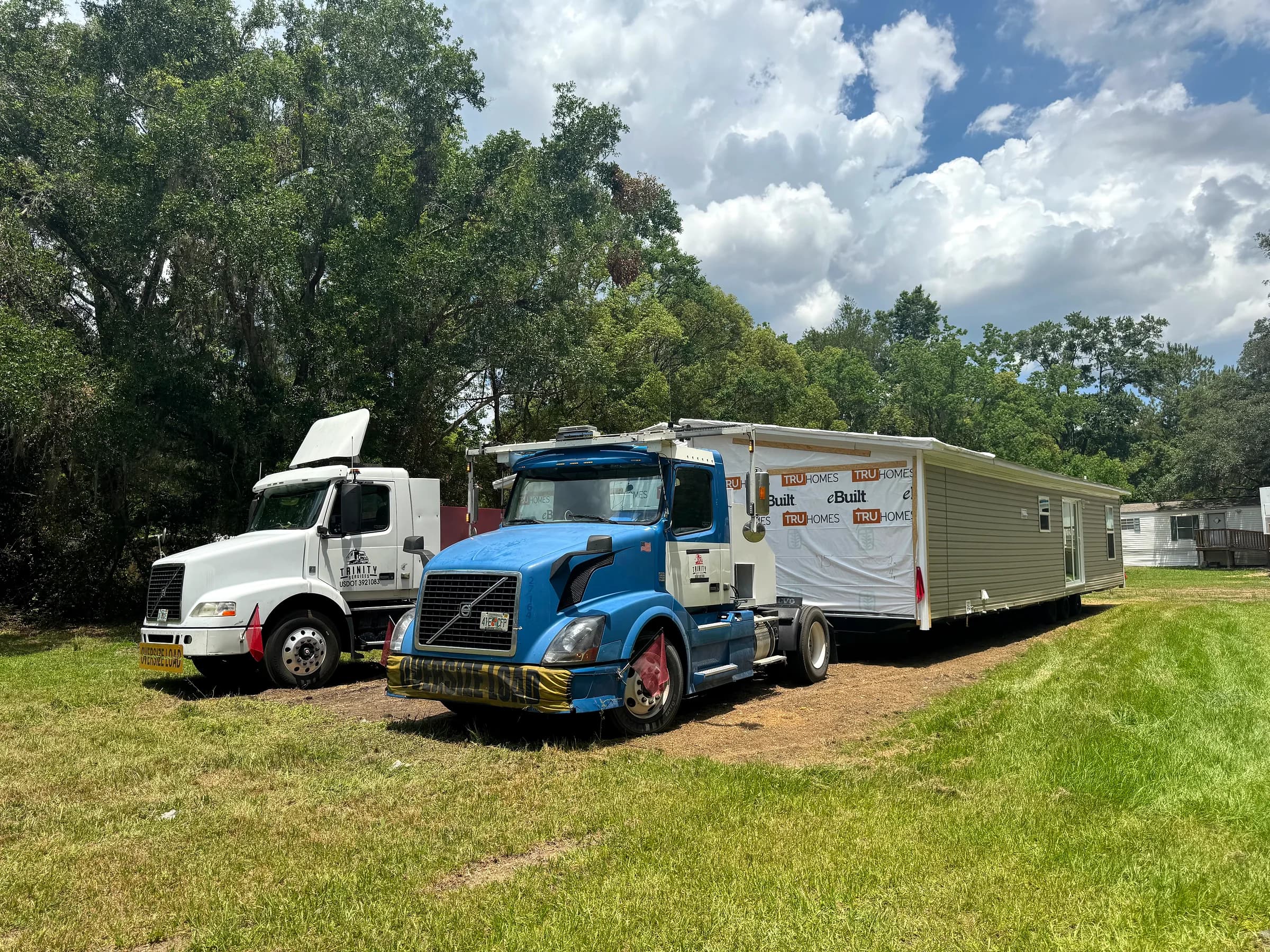
Commercial modular & office relocation
Modular office and portable building relocation in Florida.
When your modular office, multi-section complex, or jobsite trailer needs to move across the lot or across the state, we coordinate the full job: site survey, FDOT oversize permits, licensed transport, crane set, foundation reset, tie-down to Florida Building Code, utility reconnect, and county sign-off. One coordinator, one phone number, every licensed sub in place before we roll a wheel.
Unit types
What we move
Commercial DCA-insignia buildings follow a different regulatory regime than residential mobile homes. Florida Building Code plus FAC 61-41, not the HUD-code 15C-1 path. Every job is engineered for the new site. We handle these unit types:
- Single-unit mobile office trailers from 8x20 up to 12x60
- Multi-section modular office complexes from 2 to 20+ sections
- Construction jobsite trailers placed under county Temporary Use Permits
- Guard shacks, security kiosks, restroom and shower trailers
- Sales offices for modular dealers and used-unit resellers
Moving a school, charter, daycare, or church classroom? See our portable classroom moves page for the SREF, DCF, and DOH layers. See classroom relocation
Permits and licensing
Permits and licensing in three lines
The transport piece is FDOT, the install piece is your county building department, and the engineered foundation is sealed by a FL-licensed PE. Both permit tracks must close cleanly for the building to be occupied:
- FDOT oversize transport permit, pulled by the licensed oversize trucking sub. Pilot escort above 12 ft wide.
- County install permit, pulled by a FL-licensed Certified General or Certified Building Contractor under Florida Statutes Chapter 489.
- PE-sealed foundation and tie-down plan to Florida Building Code for the site wind zone (not the FAC 15C-1 HUD-code schedule).
Trinity Services LLC coordinates every licensed party (CGC or CBC sub, oversize trucking firm, crane operator, electrician, plumber) and signs one contract with you. For the full regulatory background, including DCA insignia recertification, third-party agency inspections, and the temporary vs. permanent permit paths, see our DCA building relocation guide.
How a typical multi-section move runs
- 1Site survey at pickup and delivery: access, soil, wind zone, utility stubs, route clearance for oversize haul
- 2Document audit: DCA/DBPR insignia photo, manufacturer plate, prior foundation plan, existing tie-down design
- 3Permit prep: FDOT oversize for transport, county install permit package (site plan, PE-sealed foundation, tie-down plan)
- 4Disconnect day: utility shutoff, skirt removal, tie-down release, unmarry of joined sections
- 5Jack and dolly prep on every section, pilot escorts staged
- 6Transport day: each section hauled separately, pilot escorts in position, route timed for daylight only
- 7Set at delivery: piers placed per the engineered plan, sections set by crane where access blocks road tow
- 8Re-marriage of sections: align, gasket, fasten, seal the joint top to bottom
- 9Tie-down to FBC wind zone, anchors driven and pull-tested, results documented
- 10Skirt install, utility reconnect, AHJ final inspection scheduled
- 11Sign-off and, on permanent placements, Certificate of Occupancy issued
Where commercial modular relocations go wrong
The state insignia plate inside the electric panel is what proves the building was factory-built to Florida Building Code. If it is lost, peeled, or unreadable, no county will let the building be reinstalled. We verify it before the move so a third-party agency recertification by PFS-TECO, Intertek, NTA, or RADCO is in the quote up front, not a surprise after delivery.
Every new site has its own wind zone, soil class, and exposure category. The Florida Building Code requires a site-specific PE-sealed plan for the new lot. Reusing the old plan is the fastest way to fail the install inspection.
Loads wider than 12 feet need a pilot escort. Some operators skip it and gamble on the route. A single weight-station stop voids the permit, parks the load, and adds days of delay fees.
On a multi-section building, the joint between sections has gasket, bolt, and seal hardware that has aged for years. Pulling it apart cold cracks panels and lifts roof flashing. A pre-unmarry inspection identifies the brittle spots and budgets the right repair material before the cranes arrive.
Jobsite construction trailers go in under a Temporary Use Permit tied to the host construction permit. If the project drags past the TUP window the trailer becomes a code violation overnight. We track the TUP expiration and the host permit and renew before the lapse.
Who hires us for this work
Relocating a construction office trailer between jobsites, or rolling a sales trailer onto a new subdivision. We handle the TUP and the host-permit alignment.
Used-unit dealers selling a refurbished modular to a buyer hundreds of miles away. We coordinate the dismantle, transport, and install at the buyer's site so the dealer ships fully turnkey.
Adding or relocating a portable classroom complex. DCA-insignia educational buildings need engineered foundation work plus DOH or DCF sub-approvals depending on use.
Hurricane response staging, FEMA-style mobile command, county EOC overflow. We work fast post-storm with the licensed subs already on standby.
Field offices for utility, pipeline, and remediation projects. Often deployed under a temporary use permit then converted to permanent if the project extends.
How commercial modular moves price out
Pricing ranges are industry benchmarks for Florida 2026 (Heavy Haulers, iModular, FDOT, Mobile Modular). Final quote is firm after the site survey and document audit. Subcontracted trades pass through with a coordination margin disclosed up front.
Get a coordinated commercial modular relocation quote
Tell us the unit count, the pickup and delivery sites, and your timeline. We come back with a firm quote that includes every licensed sub and every permit, in writing.